An employee handbook is the single document that tells every employee what they can expect from your company and what your company expects from them: policies, benefits, working practices, and the values behind them.
Most teams write one early, then let it drift. It rarely stays accurate on its own.
In some cases the employee handbook is even a printed document that has gone out of date.
If you’re currently trying to figure out what goes into an employee handbook, the legal ground rules it has to respect, and how to keep it current once it ships, so the version your team reads is always the version you meant - read away!
Key takeaways
- An employee handbook collects your policies, benefits, and expectations in one place, and doubles as your written record of what the rules were and when.
- Six core sections cover almost every handbook: terms of employment, workplace policies, code of conduct, compensation and development, time off, and resignation and termination.
- US law reaches into the handbook: at-will language, EEOC, FLSA, FMLA, ADA, and NLRA all touch it, so plan a legal review before you publish.
- Rolling it out means distribution people can actually reach, plus a signed acknowledgment renewed whenever the handbook materially changes.
- Handbooks go stale by default. Give every policy a named owner and update on change events, not only on a calendar.
What is an employee handbook?
An employee handbook is a single document that sets out a company's policies, procedures, benefits, and cultural expectations for its employees. Writing one forces you to check your practices against the state and federal rules you fall under, though the handbook itself is a record of your policy, not a guarantee of compliance.
This helps bring the mission and values into sharp focus for current employees and for everyone who joins later.
By using this type of document as an introduction to your workplace, new team members will have an easier time understanding how your environment works and what they should expect to do in their job roles.
That covers everything from human resources questions to how to take time off and medical leave.
Employees can also rely on this to learn how their behavior and performances will affect their working relationship with your business.
Having clearly stated protocols regarding topics such as sexual harassment or fraternizing with other employees will educate employees and their supervisors on what is or is not acceptable.
This helps to avoid disputes in the future if issues arise from these challenging situations.
Employee handbook, employee manual, staff handbook: what's the difference?
Most of these names point at the same document. If you are comparing terms before you start writing, here is what each one usually means in practice.
- Employee handbook and employee manual are used interchangeably by most companies. Some teams reserve "manual" for the longer, more procedural version and "handbook" for the shorter, culture-forward one, but there is no fixed rule.
- Staff handbook is the same document in British and Australian English. If your searches keep surfacing "staff handbook," you are reading UK-oriented guidance.
- Company handbook widens the scope slightly. It sometimes bundles brand and operating information alongside the people policies, but the employee-facing core is identical.
- HR handbook or human resources handbook is the same document named after the team that usually owns it.
- Employee procedure manual is the one genuine outlier. It documents how specific tasks and workflows are done, step by step, and often lives alongside the handbook rather than inside it. If someone asks for a procedure manual, they want task instructions, not policy.
For the rest of this guide we use "employee handbook," but the structure applies whatever your company calls it.
The importance of an effective employee handbook
Standardized policies and personnel expectations are the top reason any company with more than one employee should have a handbook. They remove confusion, give your team a path to follow when a disagreement or complaint reaches management, and support equal employment opportunity.
Other benefits of it include:
Formalizing company policies brings clarity
Some companies run on informal policies that shift depending on who handles a situation or on how each manager interprets an unwritten practice. That causes confusion, invites lawsuits, and lets your team treat inconsistent information as the standard. Writing an employee handbook forces you to define the employee policies that affect your work environment and business success, all in one location.
Create uniformity within your company
The old saying about "having everybody on the same page" rings so true when you are an employer and business owner. Your employee handbook needs to promote the idea that managers apply the rules equally within your company, so that your employees understand that these are the rules to play by if they want to succeed.
Employee handbooks spares everyone time
Imagine an employee handbook that provides crystal clear answers to frequently asked questions about your company's work culture and benefits. You save the time you would have spent answering the same inquiries, and your employees save the time they would have spent waiting for an answer they could look up themselves.
Prevents legal disputes
A carefully drafted handbook can help you defend an employment dispute: it is your written record of what the policy was and when. A carelessly drafted one can create exposure of its own, because overbroad rules on conduct, confidentiality, or social media can collide with rights the law gives your employees.
Have counsel review yours before it ships, and include an at-will disclaimer and an acknowledgment page (more on both in the legal section below).
Onboarding is speedier and straightforward
New employees find these handbooks invaluable when learning the ropes and catch up to speed. It's also a great reference tool for senior staffers, as well. Your team can take more time at making your new employees feel home and comfortable with their job.
You communicate about company culture
Whether your company takes a casual approach to office life or has a strict adherence to professionalism, an employee handbook will clearly communicate how this balances with your values and mission, and what the employee benefits are.
This especially makes sense in a remote context, where the handbook carries much of the employee experience an office would otherwise transmit.
It demonstrates compliance
Federal, state, and even local district regulations may have specific rules and protocols your company must follow. Having your guidelines laid out so that everyone knows and follows these important duties demonstrates your compliance.
Who creates the employee handbook?
Generally, most organizations rely on their Human Resources (HR) team to handle the creation of these manuals. The reason for this has to do with the specialized training, in-depth knowledge, and legal knowledge HR professionals possess.
This helps them to contextualize policy and procedures while taking note of the legal ramifications that may follow if HR fails to communicate one of those elements appropriately.
Smaller startups often don't have an HR team on hand, and leadership writes the handbook instead.
Some companies draft it collaboratively: leadership writes a rough draft and the team reviews it, which tends to surface the gaps between the written policy and the actual practice.
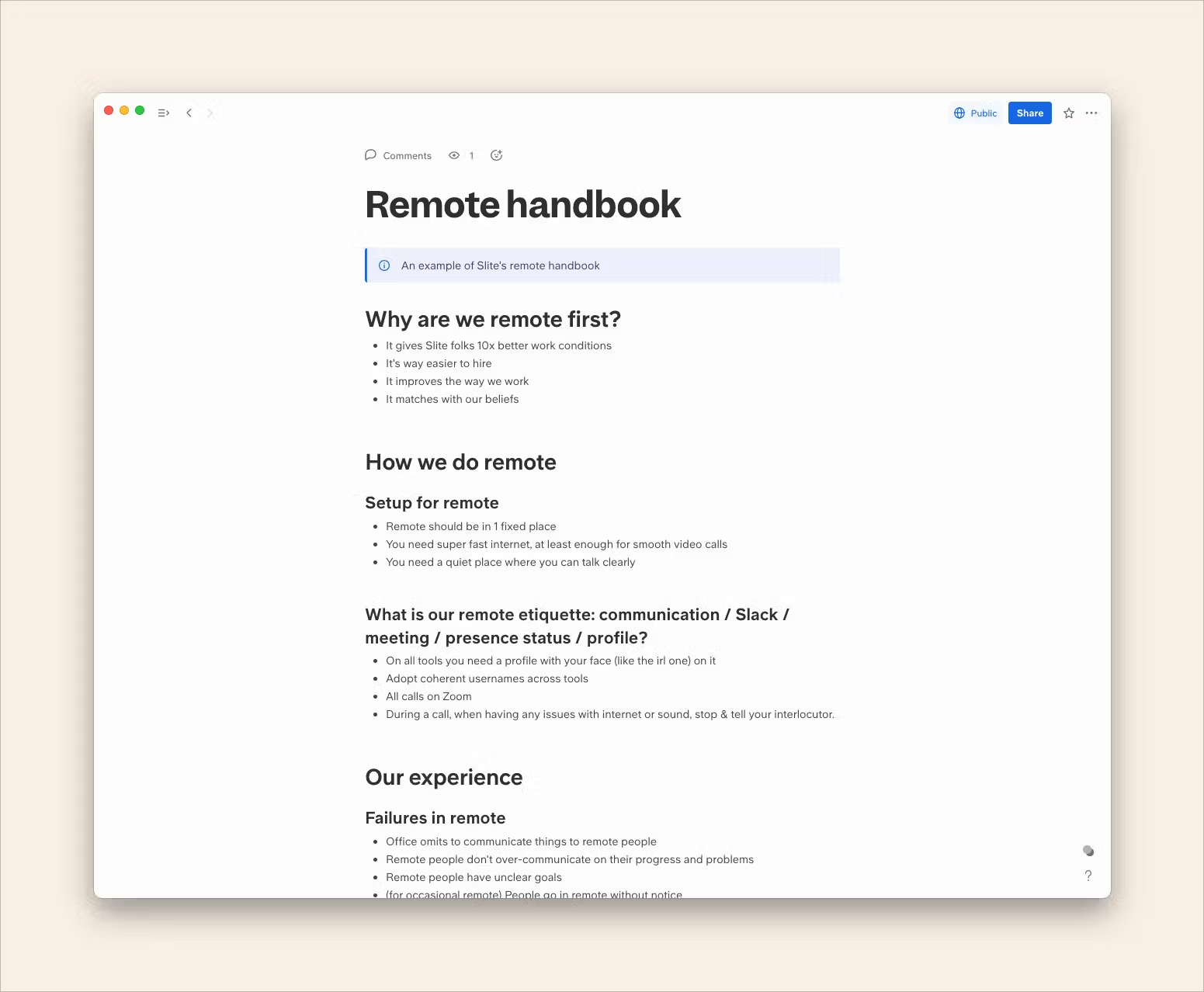
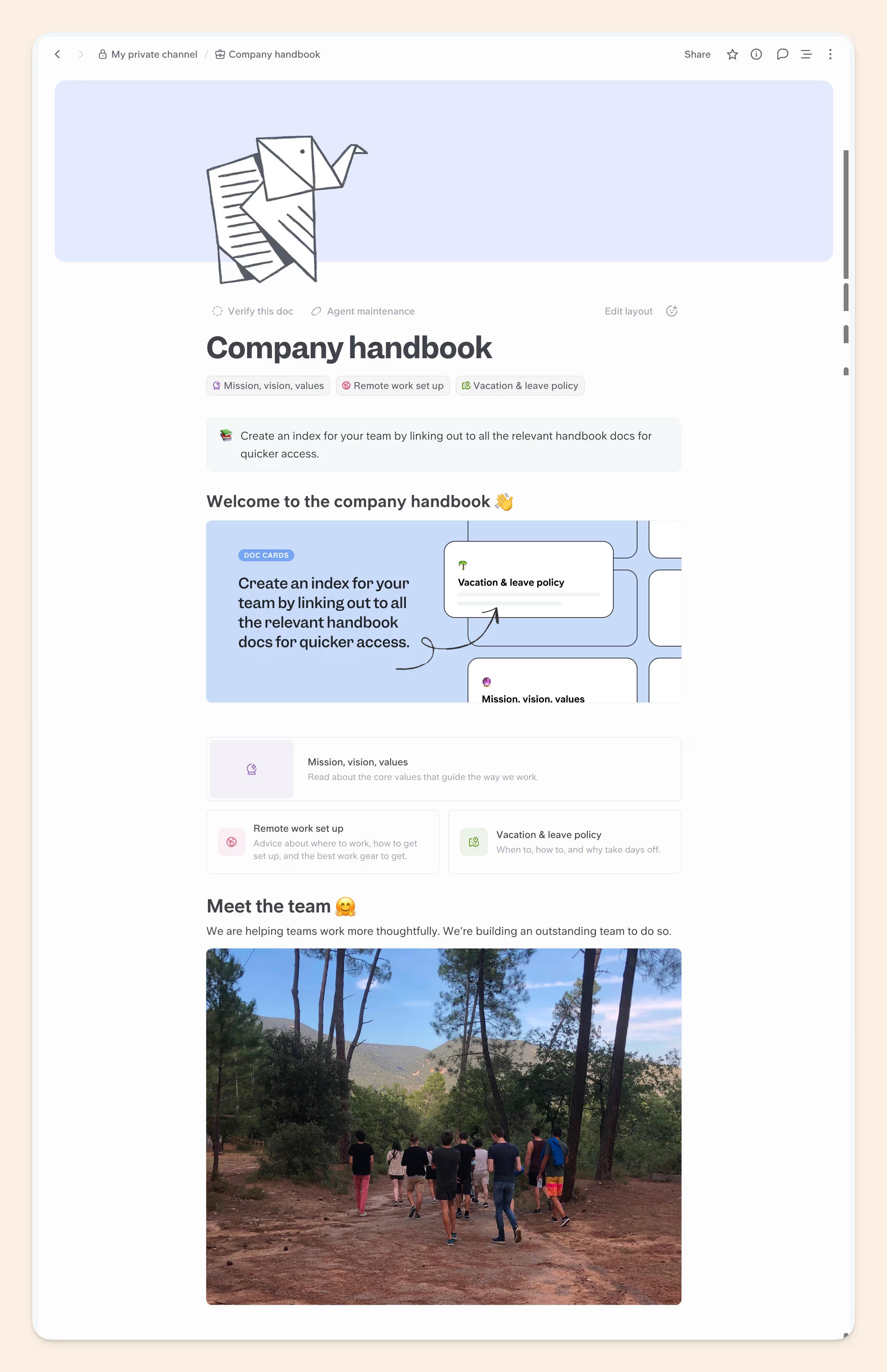
Here is how we run ours at Slite:
Our handbook is an index doc that links out to a dozen separately owned policy docs:
- time off,
- expenses and remote setup,
- contractor and referral policies,
- security onboarding,
- a code of conduct,
- plus a separate remote handbook
That way it’s not one long document.
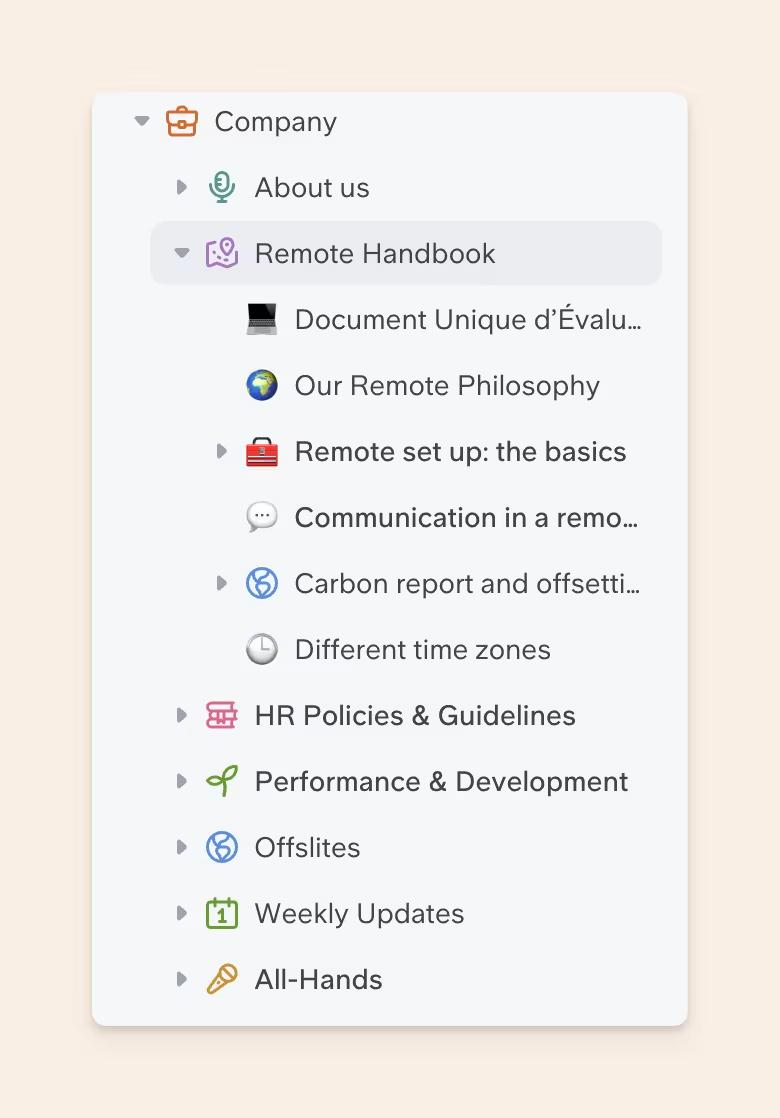
Each doc has a named owner, a review cycle, and a visible verification status, so anyone reading a policy can see whether it has been reviewed recently.
Our remote handbook even carries an "Our experience" section recording what has gone wrong for us over the years (inexplicit goals, people under-communicating progress, bad desk setups), because a policy that admits failures earns more trust than one that only states rules.
Wherever yours lives, treat the handbook as the front door of your HR knowledge base: the same ownership and review logic that runs good HR knowledge management is what keeps a handbook trustworthy.
Should you use a handbook builder, or write it yourself?
A good share of the people searching for handbook advice are really deciding whether to buy one: handbook builders, generators, and AI drafting tools all promise a finished document fast. The honest answer is that it depends on which problem you have.
A builder or generator is a reasonable call when you need a compliant baseline quickly, you employ people in one jurisdiction, and your policies are standard.
AI drafting tools sit in the same category, with one caveat that matters: they will produce plausible policy language they have no authority to warrant. A model can draft your PTO section; it cannot tell you whether that section is lawful in the states where you employ people this year. Whatever drafts the first version, the legal review described below still applies.
Should your employee handbook be a PDF or a living document?
Most handbooks start life as a Word file or a PDF. That format is easy to send, and it is where the trouble starts.
A static file has three problems. It goes out of date the moment a policy changes, and nobody notices until someone follows the old rule. It is hard to find when an employee actually needs it, usually buried in an email thread or a shared drive. And you cannot tell who has read it, which is the one thing you need when a policy is ever disputed.
A living handbook, hosted somewhere your team can reach in a few seconds, fixes all three. You edit in one place and everyone sees the current version. People can search it instead of scrolling a forty-page document. And you can confirm who has opened it and when.
The paper version still has a place. Many companies keep an exported copy for signatures, or for the acknowledgement page a new hire signs on day one. The practical pattern for most growing teams is an online handbook as the source of truth, with a PDF generated from it when a signed record is needed.
Keeping that living version current is its own discipline, which is what the next section covers.
How to build your employee handbook, step-by-step
1. Think about the big picture
What are the most important things that new hires and company employees should know about their work environment? What core values and ideals do you want to make absolutely clear to them?
2. Put together a table of contents
This will help you outline all the main points you want to cover and make writing a great employee handbook that much easier. Bring in as much information as you need, but keep the reading experience decent.
3. Establish essential company information
Make sure you cover the basics: your company's mission, background & history, core values and company policies, general tools & tips, and human resources information.
4. Make an outline
Note down the policies that will be most important and relevant to your new hires and company employees. The full list, category by category, is in the sections guide below; start from it and cut what doesn't apply to you.
5. Include management resources
Management resources set clear expectations and precedents for the situations managers actually face, and every healthy employment relationship depends on them.
Include additional templates relating to performance reviews, personnel files, meetings, and roles & outcomes.
6. Cover hiring resources
This section will be vital to new employees and help answer some of their immediate questions. Include information about the onboarding process, employment contract information, human resources, company culture, job description, and evaluation criteria.
7. Write it so people actually read it
A handbook only works if people read it, and people don't read legalese. Write in plain language, the way you'd explain a policy across a desk, and let counsel tighten the wording where it legally matters rather than starting from lawyer-speak everywhere.
Explain the why behind each policy, not only the rule. "Submit expenses within 30 days so we can close the books monthly" is a rule people follow; a bare deadline is a rule people ignore.
Keep it scannable: short sections, descriptive headings, lists where lists are honest. The same habits that make good internal documentation make a good handbook, because that's what a handbook is.
Employee handbook template
If you like what you see just below, you can start your workspace with it now.
What sections do you need in your employee handbook?
Six core sections cover nearly every employee handbook:
- Terms of Employment
- Workplace Policies and Procedures
- Code of Conduct
- Compensation, Benefits and Development Opportunities
- Work Scheduling, PTO and Leave
- Resignation and Termination of Employment
Reviewing a few employee handbook templates can help you see how these elements fit together. While this is not a definitive list due to variances in federal, state, and local laws, these give you a beginning outline for adding specialized sections under the appropriate category.
Terms of employment
This is typically the first section employees read, because it carries the most information about their own job. Treat it as the FAQ for their contract and classification:
- Attendance: what to do when an employee cannot make it to work, what notice you require, and what counts as an excused or unexcused absence.
- Employee classification: define exempt versus nonexempt and full-time versus part-time, and how privileges and benefits differ between them.
Workplace policies
This part of your handbook describes the conditions your team works within, and it is where several legal regimes reach directly into the document:
- Confidentiality and data protection: your employees handle customer information and protected product or service data, much of it now governed by privacy regimes carrying real penalties, including the GDPR in Europe and the CCPA/CPRA in California. Spell out how, when, and what workers may do with that information, and name the regimes you fall under.
- Harassment and violence: define what harassment is, state that it is prohibited, and list the consequences.
- On-the-job safety and health: your own safety protocols, the legal rules that apply to you, the steps you take when an accident occurs, and where training materials live.
Code of conduct
Separate from the harassment and violence prohibitions, your code of conduct frames everyday behavior expectations, from how coworkers treat each other to the impression left on customers and guests:
- Dress code: whether casual or professional, put it in writing. Style is subjective; a written norm prevents awkward conversations.
- Internet, devices and security: internet access, phones, social media, and email are mandatory tools for most jobs. Outline your internet and device policy clearly.
- Conflicts of interest: describe what a conflict of interest is and what steps to take so no violations occur.
- Workplace relationships: state plainly what level of fraternizing between coworkers is permitted, whether close friendships or dating.
- Nepotism: dictate which working relationships can exist between related employees, so hiring or promoting a family member doesn't read as favoritism.
- Company guests: a stated visitor policy protects your business against accident claims and data breaches, and keeps employees accountable for their guests.
- Solicitation: a colleague collecting orders for a side business at their desk can put coworkers in an awkward position. Make a clear policy about soliciting or distributing products unrelated to company business.
Compensation and development opportunities
Employees lean on this section to understand how payroll works and what growth to expect. Emphasize the policies that make staying worthwhile:
- Types of compensation: the payroll types your organization uses, which employment status receives which, and how you handle overtime.
- Performance reviews: connect an employee's performance to future opportunities, and tell managers what their role in the process is.
- Training and development: the ways employees can improve their job performance and grow; replacing people costs more than developing them.
- Benefits and perks: employees often learn about perks by word of mouth, which means your team under-uses what you already pay for. Document everything from the legal basics to the gym discount you offer.
- Employee health benefits: an overview of health insurance offerings and any wellness programs, plus your FMLA (Family and Medical Leave Act) and COBRA policies.
- Workers' compensation: an employee injured on the job will rely on this section heavily. Lay out the process, the benefits in their contract, and where to get help.
- Remote policies: remote and hybrid work have settled into a permanent share of how teams operate; roughly a quarter of paid US workdays now happen from home, a level that has barely shifted in two years despite return-to-office mandates. Put your mix in writing: who is eligible, how to request it, what equipment and security rules apply, and what in-office expectations remain.
- Expense reporting: a straightforward policy on work-related expenses, with covered charges listed, avoids disputes later.
- Company car: which expenses your organization pays, what to do after an accident, and who to contact for mechanical issues.
- Parking: how employees apply to get parking costs reimbursed or a permit issued, and when fees are due.
- Company equipment: how to care for issued phones and laptops, what to do if anything is lost, stolen, or damaged, and what liability the employee carries.
Vacation time and PTO
Employees use this section to plan their lives outside work, so write it in clear language that is easy to understand:
- Work hours and paid time off: when you expect employees to arrive and leave, how many paid days off they get and what qualifies them, and how to apply including state-specific rules like PTO payout requirements at termination, which vary significantly and can create legal exposure if your handbook language doesn't match your state's law.
- Holidays: list every holiday your business observes and how you compensate employees who work them.
- Sick leave: what qualifies as sick leave under the law and your own guidelines, plus any benefits covering short-term and long-term health problems.
- Elections and jury duty: many states have specific laws around voting and jury duty. Outline the rights that apply and any documentation you require.
Bereavement
In some states this is now a statutory entitlement, and it is larger than the customary couple of days.
- California guarantees most employees up to five days of bereavement leave following the death of a family member, at employers with five or more employees, in force since January 1, 2023.
- Illinois' Family Bereavement Leave Act, effective the same day, entitles eligible employees at employers with 50 or more employees to up to 10 workdays of unpaid leave.
Check the rules in every state where you employ people, set a company floor that clears the most generous one, and state plainly how to request the leave, what documentation you require, and whether it is paid.
Parental leave
There is always a federal floor. The FMLA entitles eligible employees at covered employers to up to 12 workweeks of unpaid, job-protected leave for the birth of a child and to bond with the newborn, and the same entitlement covers placement for adoption or foster care.
Mothers and fathers have identical rights, and bonding leave must conclude within 12 months of the birth or placement.
Covered means private employers with 50 or more employees in 20 or more workweeks; eligible means 12 months of service, 1,250 hours worked in the prior 12 months, and a worksite with 50 or more employees within 75 miles.
A growing number of states layer paid family leave on top of that floor. Confirm both layers for every state where you employ people.
Employee resignation and termination
Sometimes a job just isn't a good fit, or things change and a better opportunity is elsewhere. Whatever the reason, offboarding needs a section of its own, covering everything from disciplinary procedures to last paycheck dates and exit interviews:
- Disciplinary action: make sure your discipline process has an explained step-by-step approach, and set out what role managers play in documenting each stage. A documented process also protects workplace safety and guards against discrimination claims.
- Resignations: the notice your company expects when an employee resigns, and any tuition or relocation costs granted contingent on employment length.
- Termination of employment: the federal or state laws that apply to the decision, your internal termination process, severance where it applies, and how you pay out unused vacation or sick time. Add your reference policy here too.
What does a real employee handbook look like?
The famous example is GitLab. GitLab runs its entire company handbook as a public website, and it operates handbook-first: a process change lands in the handbook before anyone announces it, and the announcement links to the change.
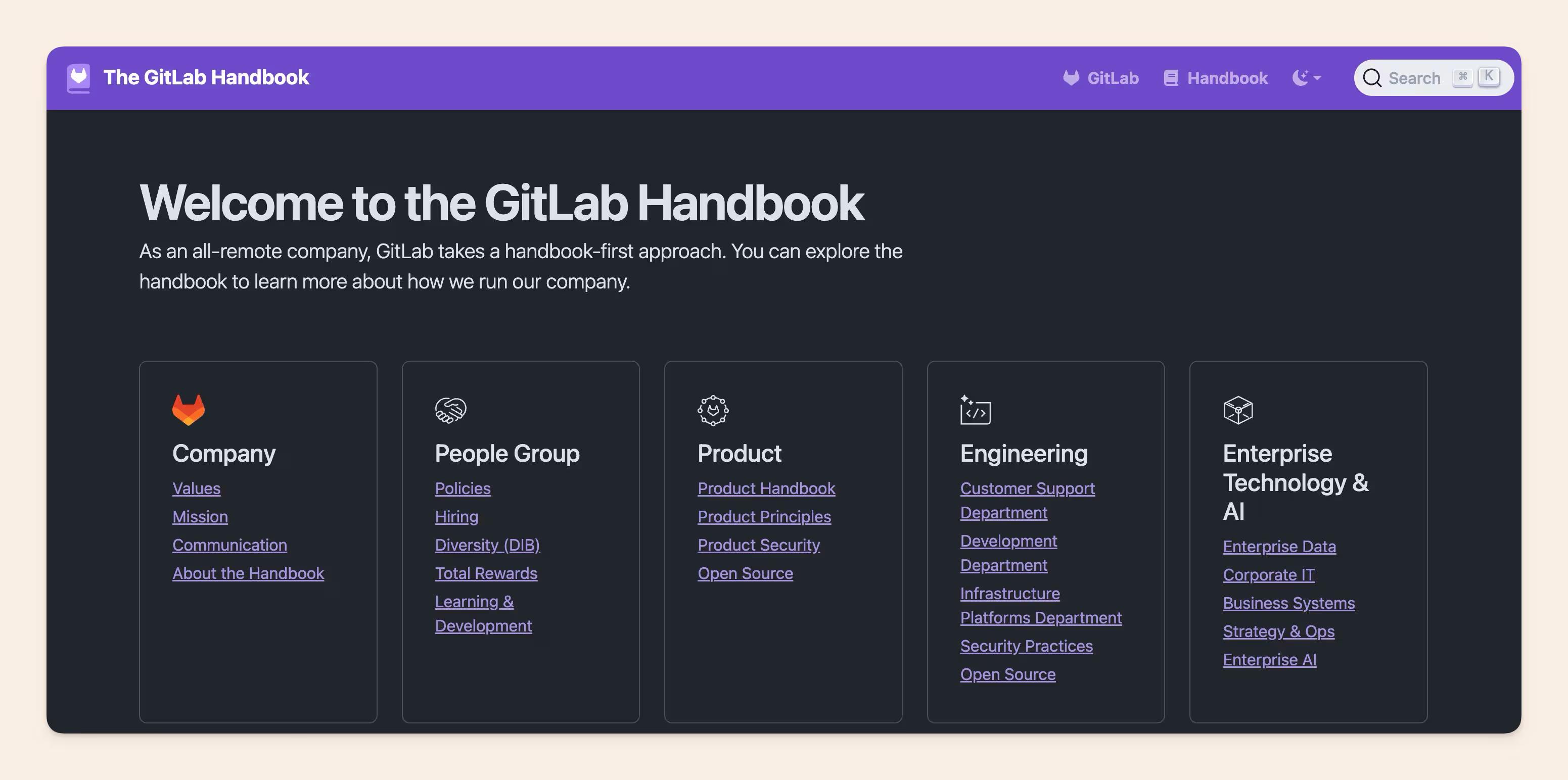
That single rule is worth stealing even if you never publish a page, because it makes the handbook the source of truth rather than a lagging summary of decisions made elsewhere. It is also the same change-event habit our own survey respondents kept arriving at, which we cover below.
The other example we can vouch for is ours, described above: an index doc over a dozen separately owned policies, each with a named owner and a visible verification status.
Different shape from GitLab's, same principle. Both treat the handbook as a system to run rather than a document to finish.
Legal considerations before you publish
Nothing in this section is legal advice, but it is the checklist we would bring to an employment lawyer. US law reaches into more of the handbook than most first drafts assume:
| Consideration | What it means for your handbook |
|---|---|
| At-will employment, and the disclaimer that preserves it | If you employ at will, say so explicitly, and include a disclaimer that the handbook is not an employment contract and does not change the at-will relationship. This is the single clause that determines whether your handbook creates enforceable obligations you never intended. |
| Anti-discrimination law (EEOC) | Your equal-opportunity, anti-harassment, and complaint-handling policies live under the federal anti-discrimination statutes the EEOC enforces. |
| Wage and hour law (FLSA) | Your compensation, overtime, and employee-classification sections need to match it. |
| Leave law (FMLA) | The federal floor described under parental leave above; your leave policies cannot promise less than it grants. |
| Disability accommodation (ADA) | Your policies on accommodation requests and on how you describe essential job functions. |
| Protected concerted activity (NLRA) | Federal labor law protects employees' rights to discuss pay and working conditions. Conduct, confidentiality, and social-media policies are the usual places handbooks accidentally cross that line, and the standard has tightened in recent years, so give these policies extra counsel attention. |
Then have the whole document reviewed by an employment lawyer before it ships, and after every material change. The cost of the review is small against the cost of a policy that turns out to be unenforceable, or worse, enforceable against you.
What to leave out
Every section so far says include more. This one says some content creates risk:
- Over-specific promises. "Employees will receive a review after 90 days" or a guaranteed severance formula can convert the handbook into a contract. Describe intentions and keep discretion.
- Rigid discipline language. A mandatory step-by-step discipline ladder removes your ability to skip steps when the conduct warrants it. Say the process is typical, never guaranteed.
- Overbroad conduct and confidentiality rules. Policies that could read as restricting employees' rights to discuss pay or working conditions are the most likely to collide with the NLRA point above. Let counsel pressure-test the wording.
- Rules you won't enforce. An unenforced policy becomes evidence of inconsistency the first time you apply it selectively. If you won't hold the line, leave it out.
If you employ people in more than one place
The wrong answers are a lowest-common-denominator handbook that is vague everywhere, or a separate handbook per location that immediately forks.
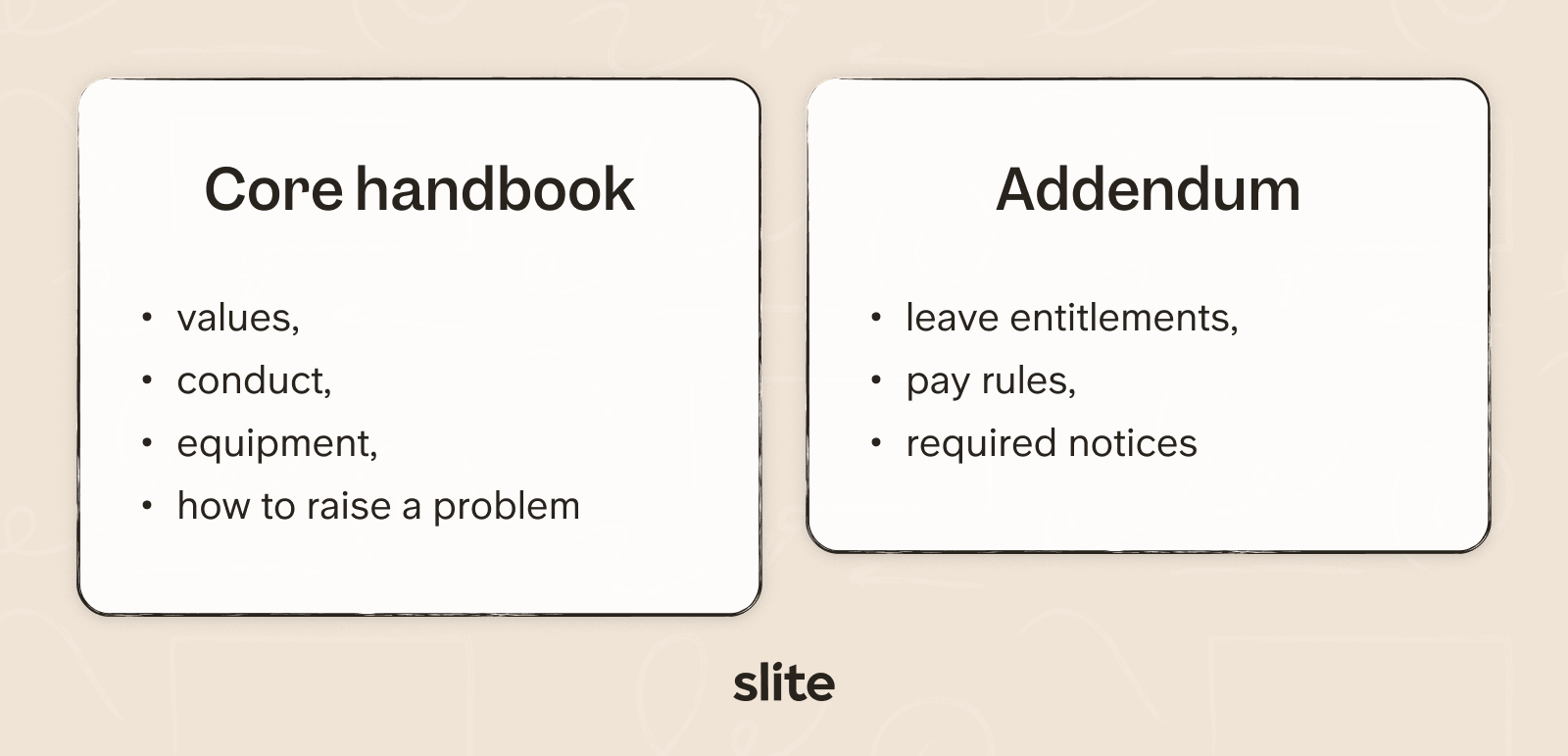
The pattern that works is one core handbook plus a short addendum for each state or country where you employ people.
The core carries everything that is true everywhere: values, conduct, equipment, how to raise a problem. Each addendum carries only what that place changes: leave entitlements, pay rules, required notices. New location, new addendum, and the core stays stable.
Keep the addenda honest the same way you keep the rest of the handbook current: a named owner, and a review whenever the law in that place moves.
Do not attempt a full survey of every jurisdiction inside the core document. That survey is a maintenance burden that will quietly go stale, which is the exact failure a handbook exists to prevent.
Remember - laws move even when your document doesn't
When we collected stories about stale documentation, employment lawyer Ed Hones of Hones Law described watching an AI tool confidently cite the old 180-day EEOC filing window after the deadline had been extended.
The law itself is easy to check: the EEOC's standard deadline for filing a discrimination charge is 180 calendar days, extended to 300 calendar days where a state or local agency enforces a law prohibiting discrimination on the same basis.
The point of the story is that nobody had told the documents, and the tool trusted the documents.
A handbook only demonstrates compliance if it still matches how your company actually operates. That is why every doc in Slite has an owner and a verification cycle: an unreviewed policy surfaces as unverified instead of quietly passing as current.
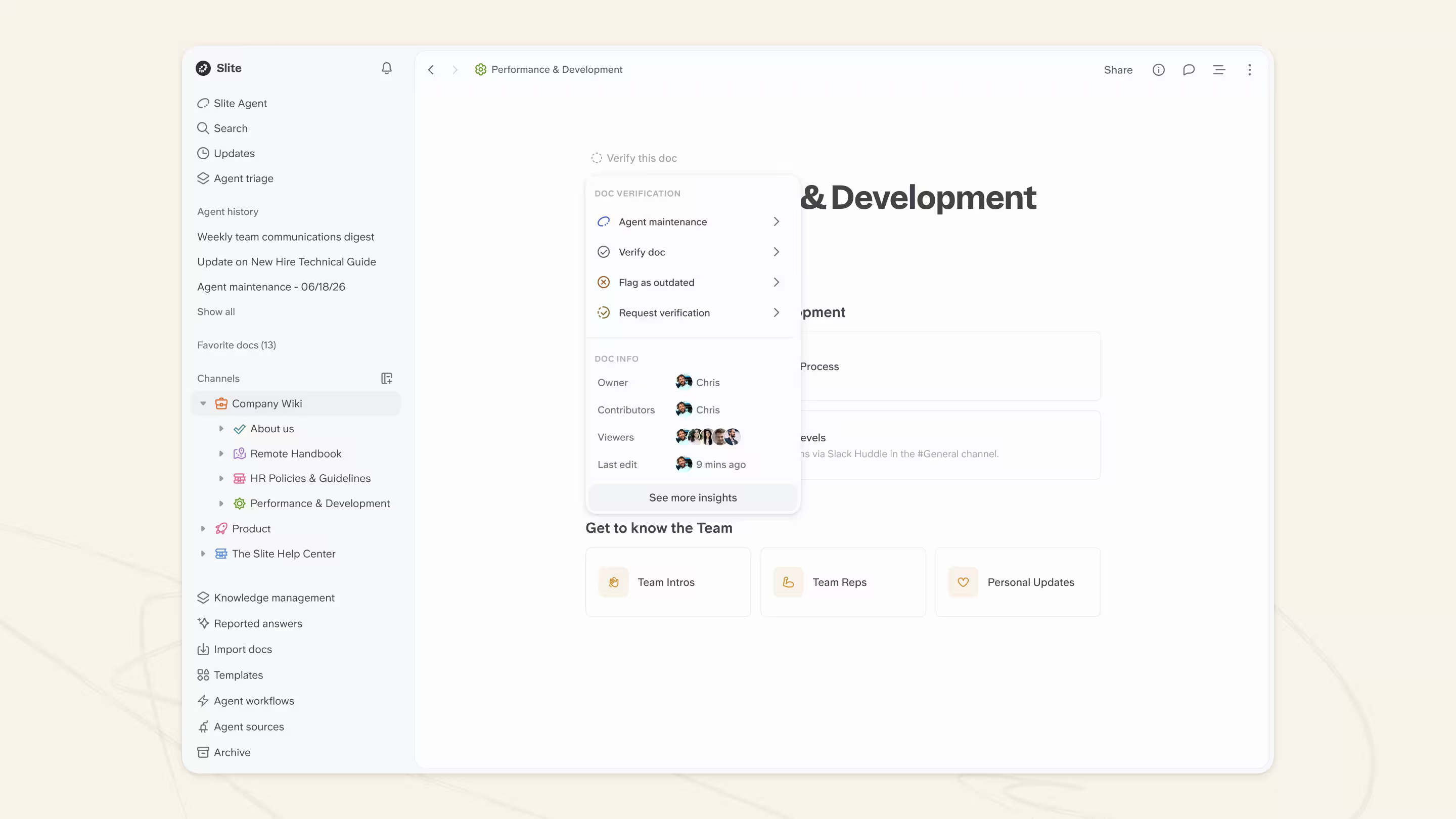
On Pro, the Slite Agent cross-references your docs against the tools your team already works in, flags where a policy has drifted from practice, and proposes the edit for a person to approve before it goes live.
If the handbook you are responsible for is the HR version of this problem, see how an HR knowledge base that maintains itself handles it in practice.
Close your employee handbook positively
Once you have the main contents of your handbook complete, write a quick overview of the purpose of the book, a point of contact for any questions, a reminder that policies may change, and an acknowledgment signature line.
Emphasize how glad you are to have each reader on board and that you look forward to working with them.
That signature line deserves more than a passing clause, because it is doing legal work. The signed acknowledgment is your evidentiary record that an employee received the handbook and had the chance to read it; in a dispute, the policy plus the acknowledgment is what shows you communicated the rule, and when. Collect it during onboarding, and store it where you can find it years later.
Distribution is the other half of rollout. A handbook only counts as communicated if people can actually reach it:
- put it where your team already works,
- make it searchable,
- and don't lock it behind a login your field staff won't maintain.
Walk new hires through the sections that affect them most instead of handing over the whole document cold.
And plan for the update case now.
When the handbook materially changes, employees need to know what changed and acknowledge the new version, so version the document and keep a record of who acknowledged which version.
The hardest part of rollout is the one the signature line hints at: verifying, on day one and after every update, that every employee has read and understood what is in it.
FAQ
Is an employee handbook legally required?
There is no general federal requirement for a private employer to publish an employee handbook. Once you have one, though, its contents are legally load-bearing: the at-will disclaimer, the acknowledgment records, and the policies themselves all matter in a dispute. Treat the legal-considerations section above as the floor, and have counsel confirm whether any location you operate in requires specific written policies.
How often should you update an employee handbook?
Update it whenever something material changes: a law moves, you cross a headcount threshold, you open in a new location, or practice drifts from the written rule. In our survey, teams that relied on quarterly reviews still reported that things slipped through, so pair change-event triggers and a named owner with an annual sweep as the backstop.
Can ChatGPT write an employee handbook?
It can draft one, and the draft will read fluently. What it cannot do is warrant that the policies are lawful for your locations, current as of this month, or true to how your company actually operates. Use AI for the first draft and the structure if it helps, then keep a human owner for the content and an employment lawyer for the legally load-bearing sections.
Can an employee handbook create a legal contract?
Yes, if it is written carelessly. Over-specific promises, guaranteed procedures, and rigid discipline ladders can read as contractual terms. The standard protections are an explicit disclaimer that the handbook is not a contract, at-will language where it applies, and never promising anything you don't intend to keep.
Do you need a different handbook for each state?
Usually not. The pattern that scales is one core handbook that is true everywhere, plus a short addendum for each state or country where you employ people, carrying only what that place changes: leave entitlements, pay rules, and required notices. Each addendum needs its own owner and its own review trigger.